


Last weekend, I needed to schedule a chimney cleaning. Simple enough. I found a local company, sent a text inquiry, and within hours got a response. The conversation started normally - friendly, prompt, professional. Then about two messages in, something shifted. The responses became oddly enthusiastic. Questions I asked got answered with information that felt... off. The pricing didn’t match their website. When I tried to schedule and put down a deposit, I hit a wall. The bot couldn’t actually do either.
Because it was a bot. Obviously a bot, in retrospect.
The next day, a human from the company called me. They had zero context about our text conversation. None. They didn’t know what pricing had been quoted, what dates I’d inquired about, or that I’d already spent 20 minutes trying to book their service. We started from scratch.
So what was the point?
This is 2025’s AI in a nutshell. Companies slapping “AI-powered” on everything, creating more work instead of less, delivering theater instead of outcomes. The bot didn’t help me. It didn’t help the business. It just... existed. Because AI.
2026 is when that stops flying.
The ROI Reckoning
We’re about to see the enterprise equivalent of “the emperor has no clothes.” Every company that rushed to bolt AI onto their customer service, their sales process, their operations - they’re going to start asking the uncomfortable question: What are we actually getting from this?
And for a lot of implementations, the answer is going to be: “Nothing measurable. Possibly negative value.”
The hype cycle is ending. Not because AI isn’t powerful - it absolutely is. But because most companies are using it wrong. They’re implementing AI where it creates friction instead of reducing it. They’re building chatbots when they need agents. They’re focused on appearing innovative instead of delivering value.
2026 is the year the market forces a correction.
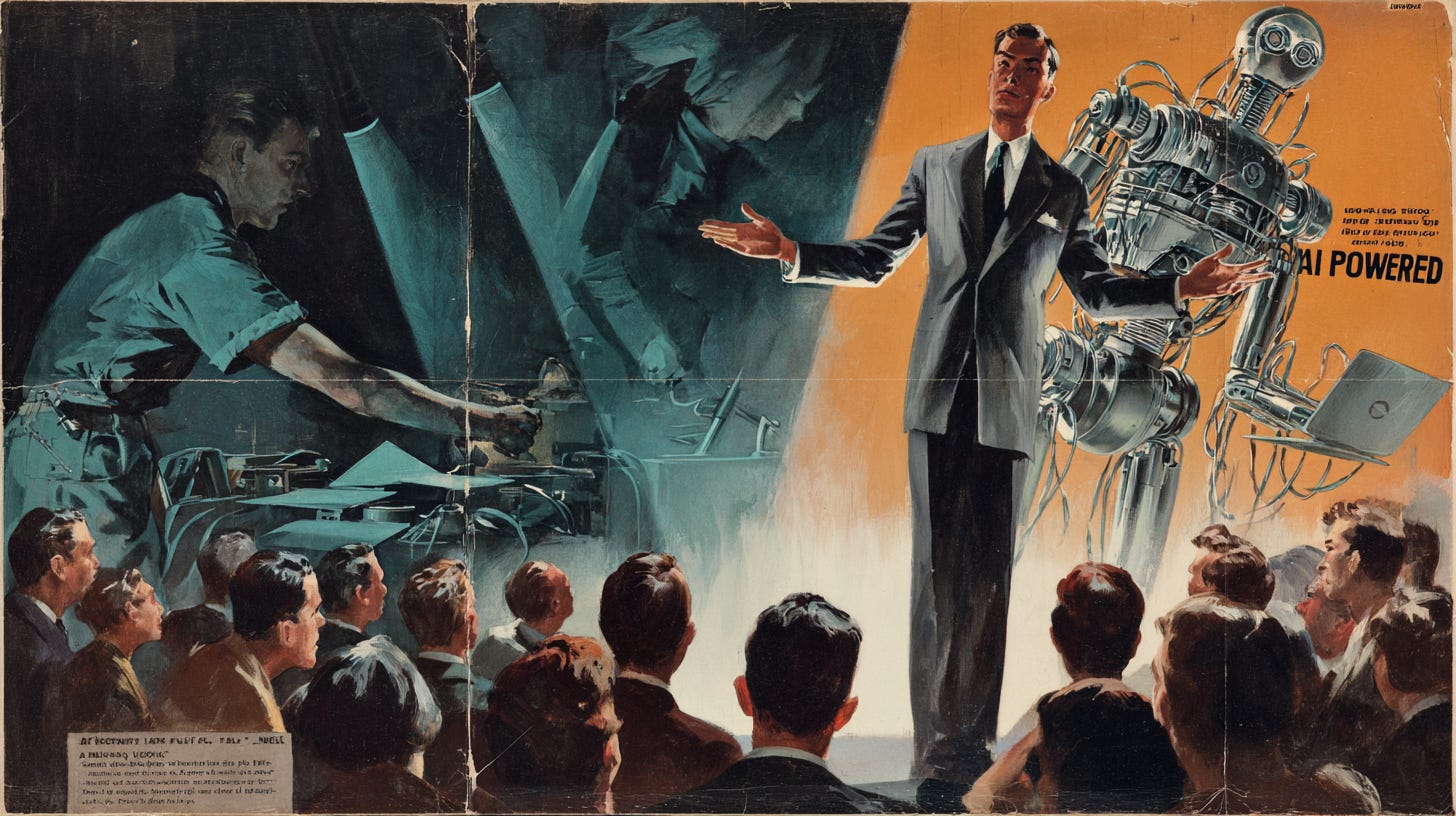
My Five AI Predictions for 2026
1. The Death of “AI-Powered” Badge Engineering
Putting “AI-powered” on your product was 2024’s marketing move. By mid-2026, it’s going to be a red flag.
Why? Because customers have learned. They’ve dealt with enough useless chatbots, enough AI features that solve nothing, enough friction disguised as innovation. They don’t care if something uses AI. They care if it works better than what they had before.
The companies that win will be the ones that shut up about the technology and talk about outcomes. “Our system reduced your time-to-hire by 40%” beats “AI-powered recruiting platform” every single time.
2. Agents Over Chatbots: The Manus Moment
Meta just dropped $2+ billion to acquire Manus - making it their third-largest acquisition ever, behind WhatsApp and Scale AI.
Manus isn’t a chatbot. It’s a general-purpose AI agent that actually completes tasks. Screen job candidates. Analyze portfolios. Conduct market research. It hit $100M in ARR eight months after launch.
That’s the signal. The market doesn’t want more conversation. It wants completion. It wants systems that take a task off your plate entirely, not systems that require you to manage and verify their work.
2026 is when the focus shifts from AI that talks to AI that does. Expect to see agent frameworks proliferate, expect to see outcome-based pricing models emerge, expect to see the definition of “AI product” fundamentally shift.
3. Unsexy AI Eats Everyone’s Lunch
You know what’s not getting venture funding? Internal workflow automation. Employee productivity tools. Backend process optimization. The stuff that makes businesses actually run better but doesn’t make for sexy demo videos.
That’s where the real money is.
While consumer-facing AI hits saturation and diminishing returns, the companies that are quietly automating their internal operations are building compounding advantages. Every manual process eliminated, every handoff automated, every decision accelerated - that’s permanent efficiency gain.
This is infrastructure AI. It’s boring. It’s invisible to customers. It’s the difference between a business that scales smoothly and one that collapses under its own operational weight.
The companies building this aren’t pitching VCs. They’re building moats.
4. World Models Become Critical Infrastructure
Current AI is pattern-matching. It reads millions of examples and predicts what comes next based on statistical likelihood. That’s incredibly powerful for certain tasks. It’s also fundamentally limited.
World models are different. They build an internal understanding of how things actually work - physics, causality, time, space. Not just “what usually happens next” but “what happens when you do X in scenario Y.”
Why this matters in 2026:
Physical operations: Robotics, manufacturing, logistics - anything that exists in real space needs systems that understand cause and effect, not just text correlation.
Complex planning: Multi-step agent workflows require understanding consequences before acting. My chimney bot failed because it had no model of how service businesses actually operate - availability, scheduling, pricing dependencies.
Simulation and verification: Before an AI agent executes a task that could have real-world impact, you want it to simulate outcomes. That requires understanding how the world works, not just how text flows.
We’re going to see world models emerge as the foundation layer for everything that matters in practical AI deployment. The companies that crack this will own the next decade.
5. Gemini’s Enterprise Play Accelerates
Google is sitting on the enterprise data motherlode. Gmail. Workspace. Drive. Calendar. Millions of businesses have their entire operational context already living in Google’s ecosystem.
If Gemini can just keep improving model quality while making it stupid-simple to turn that workspace data into functioning agents, they’ll eat OpenAI’s lunch in the enterprise market.
Why? Because the data moat matters more than marginal model improvements when you’re trying to ship actual business outcomes. An agent that can access your company’s real communication history, real documents, real calendar, real context - without requiring complex integrations or data migration - is 10x more valuable than a slightly better model that knows nothing about your business.
Watch for Google to lean hard into this advantage. Workspace-native agents. Dead-simple deployment. Outcome-focused pricing. They have the position; they just need to execute.
What This Means for You
If you’re implementing AI in your business:
Stop asking: “How can we use AI?”
Start asking: “What outcome do we need, and is AI the best way to get there?”
Most of the time, the answer won’t be a customer-facing chatbot. It’ll be an internal workflow that eliminates three manual steps. It’ll be an agent that completes a recurring task without supervision. It’ll be infrastructure that makes your humans more effective, not technology that impresses them.
If you’re evaluating AI vendors:
Ignore the tech stack. Ask for measurable outcomes from existing deployments. Ask how they handle failure cases. Ask what happens when their AI can’t complete a task. The answers will tell you everything.
If you’re building AI products:
Kill your chatbot demos. Show me the agent completing a real task end-to-end. Show me the manual process that no longer exists. Show me the time saved, the errors eliminated, the capacity unlocked.
The era of AI theater is ending. The era of AI accountability is beginning.
2026 is when we separate the builders from the bullshitters.