


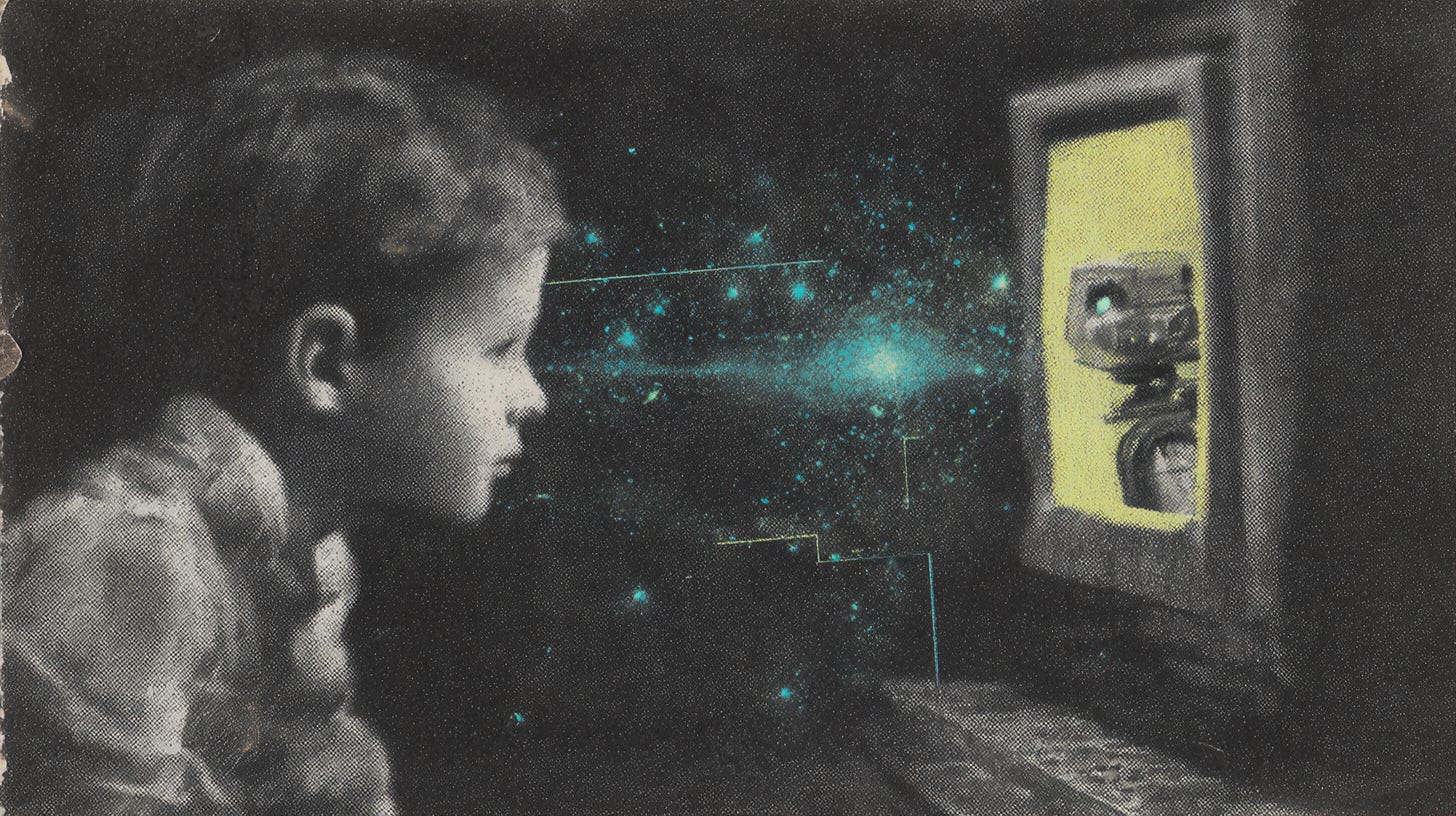
There’s too much happening in AI right now. Too many updates, too many releases, too many new products from every major player. Even if you live and breathe this stuff, it’s impossible to keep up.
We’re living through a period of innovation that, in my 37 years, feels unmatched. I’ve been through a few waves of technological wonder — enough to recognize when something genuinely shifts the human experience.
I still remember unboxing our first family computer one Christmas morning. I must’ve been eight. It came from Dell, with that enormous beige monitor and a tower that demanded its own room. My favorite program was Spider-Man Cartoon Maker. It wasn’t much, but it was magic. For the first time, I could create something digitally.
That was my first taste of transformation — the kind of shift you can feel even as a kid.
Watching the World Go Digital
Growing up through the late ’80s and ’90s, technology never stopped reinventing itself. VHS let us record and rewatch our favorite shows. Then came DVDs — crystal-clear quality that felt like science fiction.
As a sophomore in college, I remember upgrading my Netflix account when it was still mailing DVDs, just to check out its new streaming service. I was thrilled not to have to haunt the local video store, that was such a major part of my childhood.
It sounded ridiculous. And it kind of was — the first movies they had were mostly forgettable. I remember the first one I watched: Zach Galifianakis: Live at the Purple Onion. It wasn’t just my introduction to him — it was my introduction to the future.
That night, sitting in front of my laptop, watching a movie that lived online, I could feel something shift again. I was witnessing the birth of a new medium.
The Rise — and Rot — of Social Media
Then came social media. I joined Facebook back when you needed a .edu email address. I waited impatiently for my college acceptance just to sign up.
A year later, Facebook opened up to everyone, and suddenly, the floodgates were open. I joined Twitter before it had a purpose — when it still felt like a half-finished idea with potential.
But while I loved technology, I never loved sharing my life. Something about posting my every thought or meal felt… off. Performative. I remember thinking, even back then, that this might not end well for us as a species. That maybe constant visibility would do more harm than good.
So I opted out. I built computers, learned design, explored new software — but I kept at least one corner of my life analog. I didn’t want to perform online. I wanted to live offline.
The New Frontier
Fast forward to now — the rise of modern AI.
Sure, “artificial intelligence” has existed as a concept since the 1950s, but the consumer version — the one any of us can touch — that’s new.
Using ChatGPT for the first time felt like opening that Dell box all over again. It was the same spark. A technology I’d always known was out there, but suddenly it was in my hands. I could talk to it. Shape it. Create with it.
AI doesn’t feel like social media. It’s not built for clout or attention. It’s a tool. A hammer. A saw. Something that can build or destroy, depending on the person holding it.
It’s the great accelerator — not because it replaces our knowledge, but because it amplifies what we can do with it. You can build an app in an afternoon. But when something breaks, you’ll still need to understand the foundations. AI doesn’t remove the need for knowledge — it just compresses the time it takes to gain it.
The Overwhelming Present
The pace of advancement is staggering. Every week brings “groundbreaking” news — until the word loses meaning. Every day, something that felt impossible yesterday becomes casually normal.
This is the Blu-ray vs. HD-DVD phase of AI. Competing standards, rapid evolution, no clear winners — but every iteration gets us closer to what’s next.
And someday soon, it’ll slow down. The wave will crest. We’ll settle into a rhythm. Innovation will become incremental again.
When that day comes, part of me will be relieved. It’s exhausting to feel behind before you’ve even started. But another part of me will mourn it — because this era, this wild, chaotic, creative explosion, is the last great leap I’ll probably witness in my lifetime.
Why I’m Documenting This
I’m not learning AI because it’s trendy. I’m learning it because I’m fascinated. Because, for the first time in decades, I feel that same childlike awe — that sense that the future just cracked open a door and handed me a key.
I’m not at OpenAI or Anthropic. I’m not an AI researcher. I’m a human trying to understand how this thing fits into life and work — how it can make us more capable, creative, and curious.
Every week, there will be a hundred more updates. Next month, a thousand. But someday, the pace will slow, and the noise will fade. When it does, I want to be able to look back and remember what it felt like to live through this — to feel the hum of progress in real time.
Because this moment — right now — may be the last time in our lives that technology moves faster than our ability to imagine what it can become.