


James Ernst, Core Order, in conversation with Jeremy Rivera on Unscripted Small Business · Full episode
What follows is mostly James Ernst talking. The connective tissue is drawn from what is already published on the Core Order blog, because the interview and the writing turn out to be one continuous argument — he names a structural problem, then refuses to let you solve it by shopping.
The origin: eighteen years, one restaurant, four years of AI
“I started my career about eighteen years ago doing marketing and public relations. I’ve been working typically at agencies all throughout the country. Also spent a brief three year stint running my own restaurant in Buffalo, New York. So that was a fun dive into entrepreneurialism.”
— James Ernst
“I really got into AI probably about four years ago, just with theoretical things. I was working at a white-labeled web development company … especially with image generation. I have a lot of my nerdy hobbies like Dungeons and Dragons, so that’s what guided me into start playing around with some of the tools.”
— James Ernst
Two of those years have been full time in AI. The PR background matters more than it looks — it is why his diagnosis is about organizational communication as much as technology.
“Not which tool should we buy”
“Core Order is a growth architecture firm. The one thing that we have seen is AI is becoming just this plug and play with everything. There are so many tools popping up that people want to just sell you and get embedded in your business.”
— James Ernst
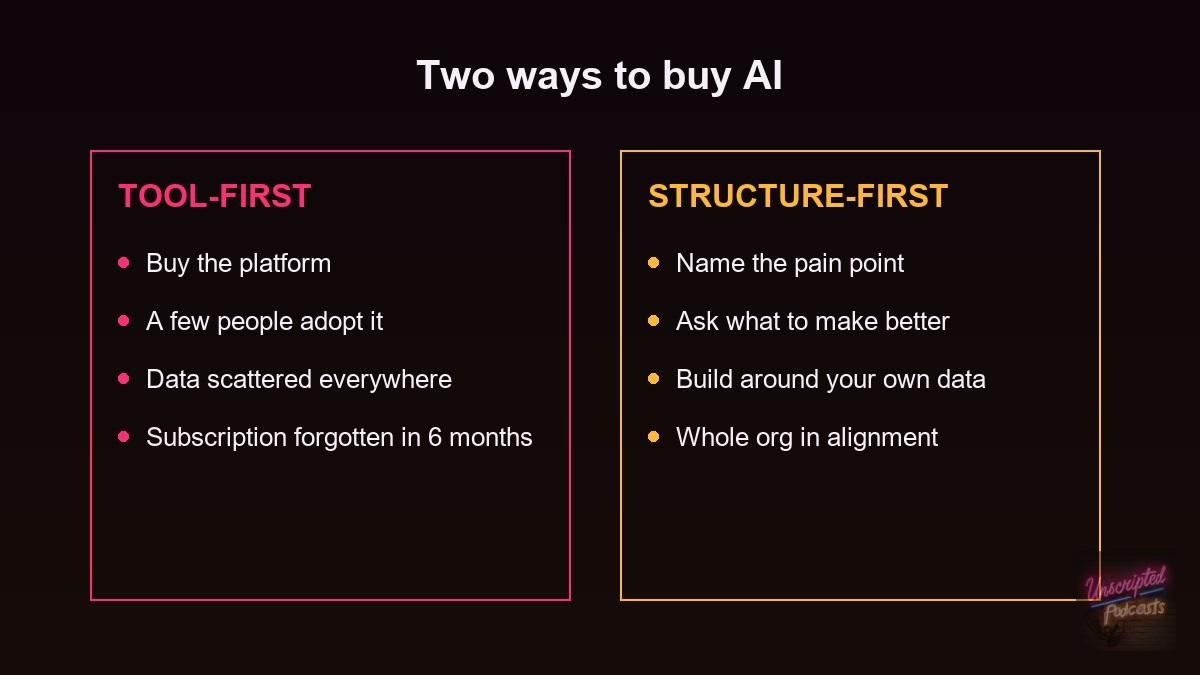
“Different departments and companies, different organizations just keep buying tools, investing in them. A few people use them, but your data is skewed everywhere — and we know that AI is most powerful when it can leverage data.”
— James Ernst
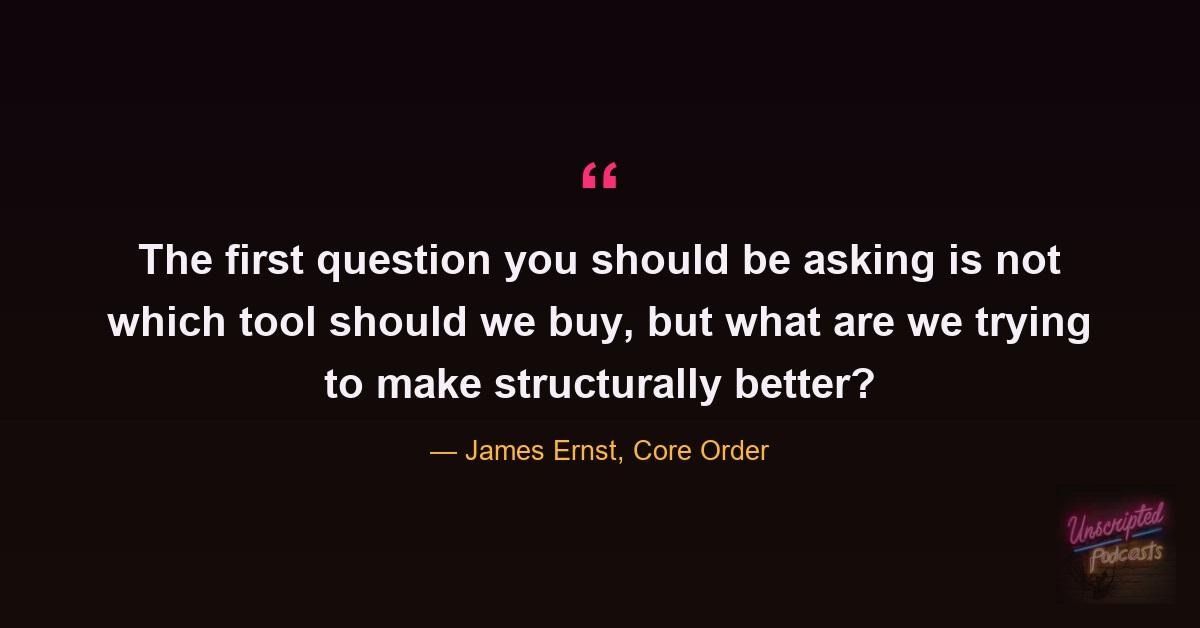
“The first question you should be asking yourself is not which tool should we buy, but what are we trying to make structurally better?”
— James Ernst
From his writing: the Architecture Gap
The interview version is the compressed one. In What Is Growth Architecture he gives the failure a name: the Architecture Gap — “the absence of a discipline responsible for designing how an organization’s departments, data, workflows, and tools connect and operate as one system.” His sharpest line there is the one this article is titled after: the AI tools work; the substrate they operate on does not. He also notes what makes it so hard to see from inside — each department’s behaviour is “locally rational” while the collective result is disorder.
“So that’s really the approach that we’re taking: working with small to medium sized businesses of how can they tackle these pain points and these problems and come up with a solution that’s really going to benefit them long term — and not just be another investment in a tool that sits unused for six months and somebody forgets they signed up for a subscription.”
— James Ernst
From his writing: the numbers behind that sentence
Why Enterprise AI Investments Fail stacks up the evidence: MIT’s Project NANDA finding that 95% of enterprise AI initiatives produce no measurable business return; RAND reporting more than 80% of AI projects fail, twice the rate of non-AI IT projects; McKinsey’s 2025 survey where eight in ten organizations cite data limitations as a roadblock. The one worth memorizing is BCG’s 10-20-70 rule — only 10% of AI value sits in the algorithms, while 70% depends on people and processes. That is the arithmetic case for doing architecture before procurement.
Homebrew, off-the-shelf, and the rogue agent
“I think there’s a perfect balance between the two, honestly. I’m homebrewing tons of stuff. I have my own AI Jarvis that runs my entire life right now outside of work.”
— James Ernst
“We’ve all heard the horror stories of somebody letting a rogue agent just wipe out a ton of data in a company because they don’t know what they’re doing and they’re following a YouTube tutorial.”
— James Ernst
“How do we look at something that you’ve already invested in in a company, like maybe a CRM that has an MCP server, or we can leverage within API access, and pull that data into a custom homebrew solution? So your data stays secure, but now you’re leveraging it with the power of what you can actually do with AI.”
— James Ernst
“There’s gonna be some great tools out there that have millions and billions of dollars invested into them that you’re just not gonna beat with a homebrew solution. But for a smaller company, maybe something custom built that is serving its purpose on a specific workflow that speeds up your team and allows your human team to actually focus on what they do best might be the best solution.”
— James Ernst
The two objections: security and hallucination
“The two biggest that I’m always hearing … are the security of it, as well as the ability for AI to hallucinate. So how do you make sure that it’s just not gonna go out and start making up data points, start filling in gaps that it doesn’t know? As well as, how do we know if we give it access to data it’s not gonna do something malicious with that data?”
— James Ernst
“We do a lot of that with feeding it only into a specific database that we have completely locked down, to be able to run mathematical computations and things like that. But anything with AI, you want to make sure that you’re taking that security absolutely seriously.”
— James Ernst
“That’s one thing that we’re having conversations with a lot of clients: making sure that they are set up on their enterprise or business accounts, that the AI models aren’t being trained. Or we’ve been talking to a lot of people about leveraging open source locally hosted models to really make sure things are locked down.”
— James Ernst
“Err on the side of caution before just giving it open access to everything.”
— James Ernst
Guardrails go in during discovery
“You have to be very specific. Especially if you’re working in a healthcare space with HIPAA, any of these regulated industries, you have to make sure that it is absolutely accurate and not going off the rails or not hallucinating.”
— James Ernst
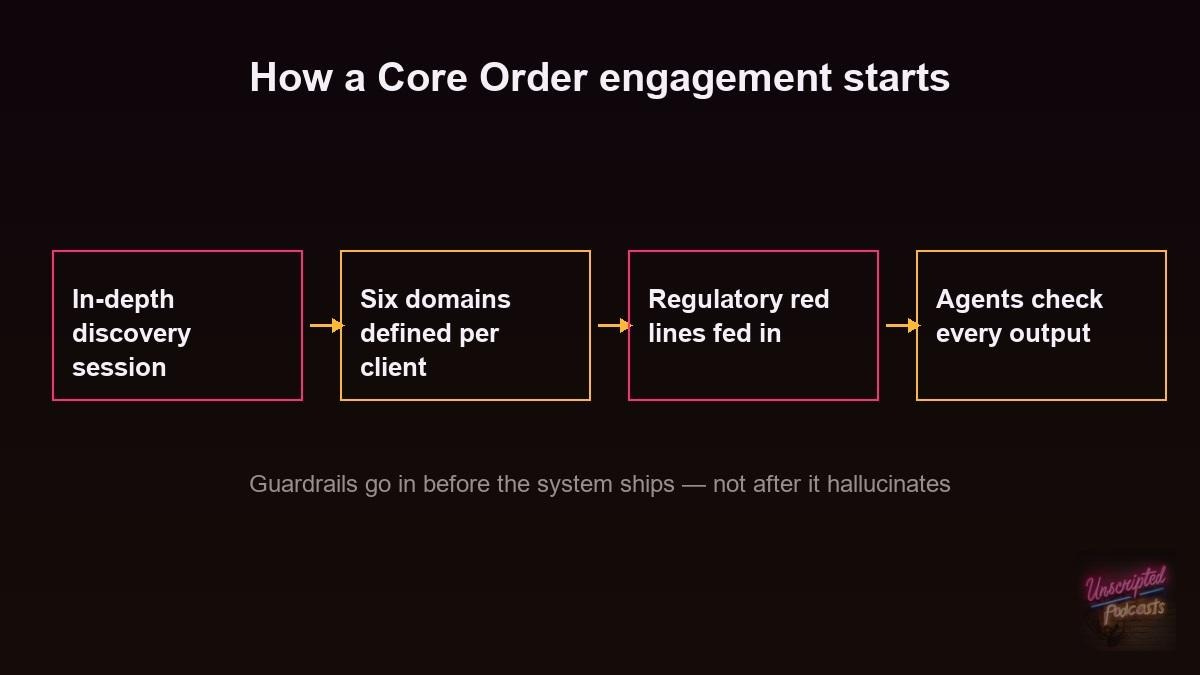
“What I always recommend, and what we do at Core Order, is a really in-depth discovery session that kicks off everything that we do. And then we have our six domains that we come up with for every client, that then helps feed the true AI system that we are working and deploying with them later on.”
— James Ernst
“Through Claude MD files or instruction MD files, we’re really limiting where the hallucinations could go off, and creating agent systems to always go back and check in on making sure that any artifacts that are produced or any workflows are not coming up with things that aren’t a part of that approved language.”
— James Ernst
Host Jeremy Rivera pressed this point using his own consulting work with PureAire, where claims about an oxygen monitoring system are tightly constrained — and where a helpful, unconstrained assistant is a liability rather than an asset.
That exchange opened onto the other half of the problem, which James is candid about not chasing yet: what the models say about you externally. Rivera’s framing, borrowed from Matt Brooks at SEOteric, is that the answer engines are already an untrained customer support team for your business. His example was the launch of a data center energy solution in Texas, where he cross-referenced some thirty published PR articles against what the company’s own site actually claimed, and treated the gap as the deliverable. James’s response was to place it firmly on the roadmap rather than the current scope:
“We’re not too focused on looking at how messaging is being pulled into large language models and coming up on Perplexity or Comet or any of the AI search engines right now. But that is definitely something that I know we will be walking into as it becomes more prevalent.”
— James Ernst
The agent swarm, and the number
“One of my favorite ones to talk about is for an agency partner of ours. We created a solution that allowed them to automate research of a prospect … you would take just basic information like domain, contact name, anything you could feed it that would start the agent swarm that we essentially created to go off and do research.”
— James Ernst
“So it’d go and look at the website, create markdown files, leverage different AI tools like Tably to go off and find related PR pieces that had official backlinks back to the site, so it knew it was a trusted source.”
— James Ernst
“What we have seen from the initial feedback is it gives the sales team a much stronger talking point to go in — as well as it’s something that they can actually show that prospect: this is something we’re able to do with AI.”
— James Ernst
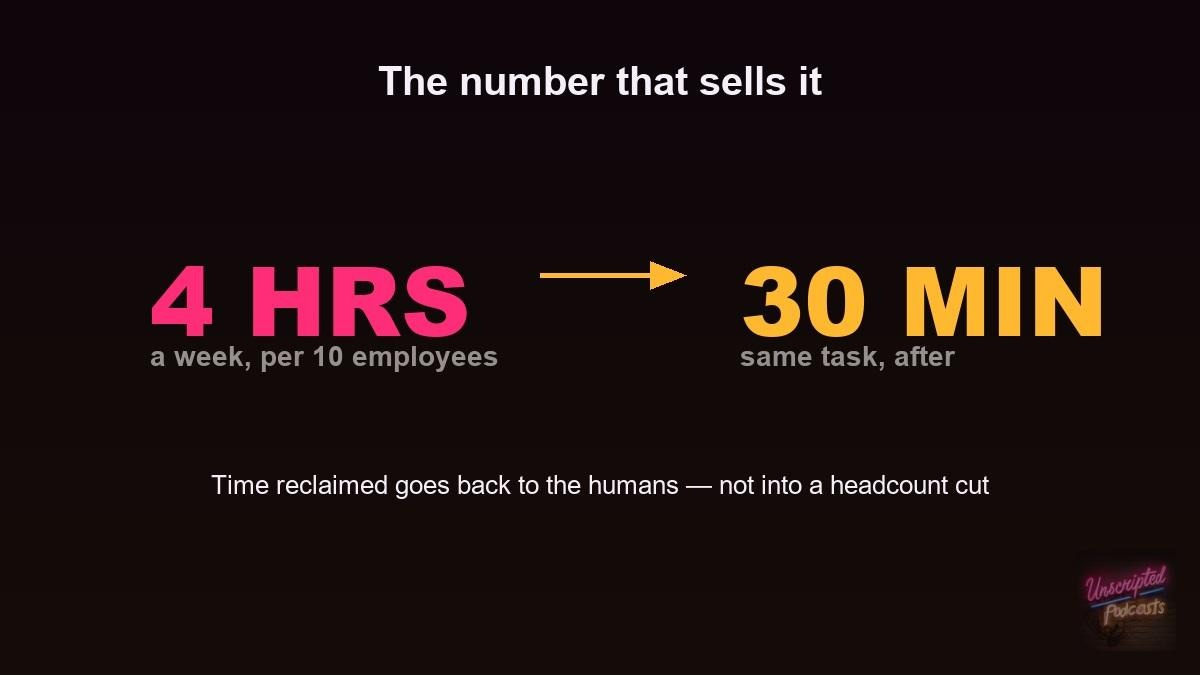
“Whether that is finding a task that takes a company a good four hours a week per ten employees, and finding a way to bring that down to thirty minutes, by leveraging that time and allowing them to focus on what’s actually gonna move the needle for the company.”
— James Ernst
From his writing: optional vs. operational
The Capability Premium explains why that distinction decides the outcome. 88% of organizations now use AI, but only 6% qualify as high performers capturing 5% or more EBIT from it — and those high performers were 3.6× more likely to fundamentally rework workflows when deploying it. His examples are structural rather than cosmetic: Klarna did not add a chatbot, it “rebuilt the customer service operating substrate”; Morgan Stanley made code review “part of the workflow itself.” A University of Chicago study found firms treating coding agents as optional saw modest gains, while those making them the default workflow saw a 39% increase in weekly code merges. His formulation: “Optional AI accumulates as a sidebar. Operational AI changes what the function does.”
Which industries, and what actually predicts success
“We’re industry agnostic. We’ve worked with a lot of manufacturing companies, we’ve worked with lots of professional services firms. We’ve seen interest in some financial services firms and medical industry as well, some med tech.”
— James Ernst
“There are pain points in every industry. So I think that’s where AI is cutting through those industry guidelines — there’s always a pain point that’s there. You can see the frustration on a workflow that takes a company a long time to get through.”
— James Ernst
“It doesn’t have to be perfectly stored. That’s the beauty of AI: we can parse it and look through it and help guide that experience. But as long as you are aware of where your pain points are, what you want to accomplish with it, and have that understanding of we want to solve X, Y, and Z and not just implement AI — that is what’s gonna help a company actually implement this and stick with it.”
— James Ernst
Superpower or distraction
“What I warn all of my friends and colleagues that are in the small business, running their own business — my wife owns three herself right now — AI could either be a superpower or a distraction.”
— James Ernst
“Especially if you get nerdy about this stuff like I do, keeping up with every model release, keeping up with every new workflow, every new tool that’s out there could be overwhelming. And as a small business owner or as an entrepreneur, you have so much on your plate that you’re juggling at any time, that adding that extra thing to try to figure out could be a pursuit of saving time, but it could also distract you from running your business.”
— James Ernst
“Let an agent do something just like you would hire an expert to be your CFO or your chief operating officer. Because we all have strengths and weaknesses in your entrepreneurial spirit.”
— James Ernst
Time, and the argument he refuses to make
“I think the pain point that resonates most is a lack of time. Especially with AI, and just the rate of speed that the American economy pushes people to grind constantly.”
— James Ernst
“People feel the need to constantly perform. They feel like they’re behind because AI can now produce so much more. We’re creating much more than we ever have before, but it doesn’t feel like enough, because with AI we could do more.”
— James Ernst
“I know there’s a lot of people that have conversations of how do we reduce workforce, things like that. And that’s never the approach that we take with it.”
— James Ernst
“It is how do we make your workforce — your humans that actually keep your business alive and thriving — and give them back the time to really do what they enjoy most. Whether that is a financial analyst who’s digging into the numbers, or a recruiter that’s helping somebody find a job … and really keep that human element, the human in the loop, as a part of this.”
— James Ernst
Imposter syndrome at the frontier
“My wife is very tech savvy. As I said, she runs three businesses … But as I talk and even just show her what I’m doing with my fun projects, I could see that she is now where I was on AI three years ago, just working in the chat interface. And now I’m dealing with agents.”
— James Ernst
“I never became an official machine learning expert. I’m self-taught as a developer. But I have been around this and learning it, and I could write my own code … you have these moments of like, can I do that because of the AI, or can I do that myself?”
— James Ernst
“AI can be scary and I think there’s a lot that we need to take caution with it. But Pandora’s box has been open and now we have to learn how to navigate within it.”
— James Ernst
The part he will not automate
“I do a lot of writing. I don’t leverage AI to write anything for me, because that is something that is such a part of the human process that I want to keep that.”
— James Ernst
“We’re gonna see AI advertisements becoming more commonplace. I remember during football season last year watching local ads that are clearly made completely out of AI, and spotting it right away.”
— James Ernst
“I think that this AI has the potential to be the great equalizer. It’s gonna allow people to accomplish things that they weren’t able to before. But I think we’re gonna see that human piece of it really shine through, and find an appreciation for human creativity, human thought, and just human empathy, by having these tools be more prominent in our day-to-day life.”
— James Ernst
From his writing: what is actually scarce
Intelligence Is a Commodity makes the “great equalizer” remark precise. With AI spending reaching $1.5 trillion in 2025 and frontier models converging, intelligence itself is the abundant input; what stays scarce is the organizational capability to use it. “Consumption is not the same as capability. Buying intelligence is not the same as building an organization that can benefit from it.” His conclusion is the uncomfortable one: more intelligence applied to fragmented systems does not compound value, it accelerates existing dysfunction.
Where to find him
“You can check us out at coreorder.ai. We have a small blog on there. We put a lot of thought pieces up and we’ll be producing a lot more in the coming months. Also I’m highly active on LinkedIn, so feel free to connect with me on there … And I’m always happy to chat and dive into a conversation about AI with anyone.”
— James Ernst
SOURCES
Direct quotes are from the Unscripted Small Business episode recorded 2026-07-29 (watch). Supporting material is from James’s own essays: What Is Growth Architecture, Why Enterprise AI Investments Fail, Intelligence Is a Commodity and The Capability Premium. Connect: coreorder.ai · LinkedIn · contact.
The architecture gap is REAL