


There is a moment in most AI programs that looks like a success and is in fact the beginning of failure. It happens about a week after the first automation goes live. The team is relieved. Someone on the leadership Slack writes “this is huge.” A press release gets drafted. Maybe a board update. The phrase we’re seeing real value from AI starts appearing in conversations with people outside the company.
I want to be careful here, because the win is real. The hours are saved. The invoices do get processed. The morale lift is genuine. But the meaning leadership assigns to that win is almost always wrong, and that interpretive error is what kills more AI programs than any technical failure.
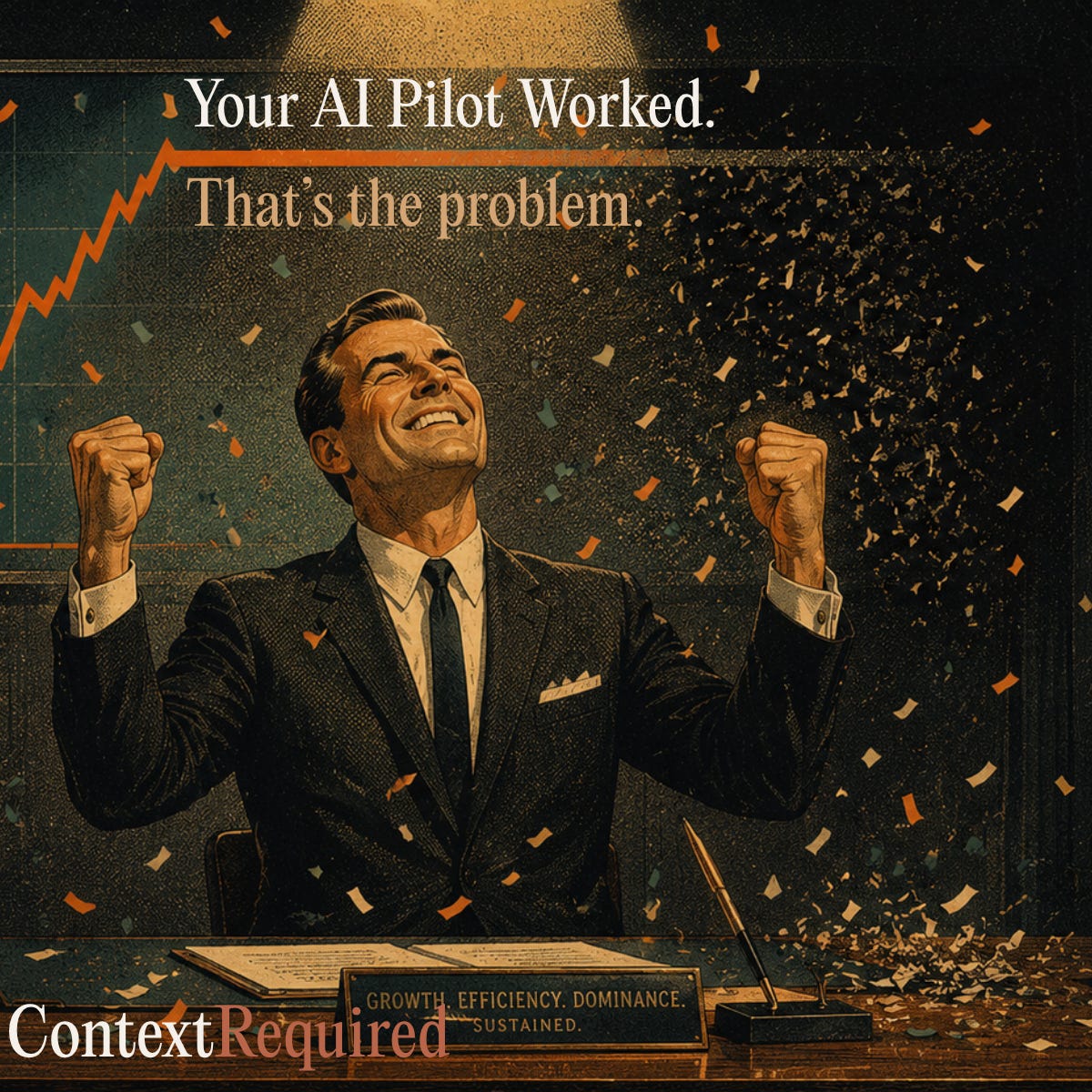
Here is the specific cognitive trap. Your brain takes one successful automation and codes it as evidence of a working strategy. It isn’t. It is evidence of one successful automation. The sample size is one. The story you tell about it, we’re doing AI, is doing all the work. The underlying capability is not.
The reason this matters is what comes next. You go looking for automation number two and discover the obvious target is already gone. You picked it first, because it was obvious. Every subsequent candidate is harder, less visible, more entangled with other systems, less politically free. The first win was the easiest win you will ever have. Treating it as the template for everything that follows is a category error.
This is where the macro data starts to make sense. BCG found that 74% of companies struggle to scale value from AI. McKinsey’s 2025 State of AI survey found only 33% have scaled AI enterprise-wide. The shorthand explanation is that these companies didn’t try. They tried. Many of them shipped a first automation that worked. What they didn’t ship was a second one, a third one, and a system for choosing the next one. The pilot didn’t fail. The follow-through did. And the reason the follow-through died is usually traceable to the celebration of the pilot, which made it feel like the work was done.
The press release is the problem. Once leadership has told the board that AI is delivering value, the political and cognitive incentive shifts away from the messy work of finding the next opportunity and toward maintaining the narrative of the win that already happened. The pilot becomes a museum piece. The team that built it gets reabsorbed into other priorities. Six months later somebody asks what happened to the AI program, and the honest answer is: it became one slide in a deck.
There is a related deception worth naming, because it has a research analog. The first-win selection bias means the first automation is unrepresentative of the work that follows. You picked something with a clean input, a clear output, an obvious manual baseline, and a stakeholder who wanted it. You will not encounter another problem with that shape for a while. The next dozen are scrappier, more political, more dependent on systems you don’t fully control. If you generalize from the first one, you will under-resource everything that follows and conclude AI doesn’t scale. AI scales fine. Your sample didn’t.
So what is the move.
The move is to refuse the celebration and replace it with a cadence. Not a one-time post-mortem. A recurring review that treats every automation, including the first one, as one observation in an ongoing data set. Every two weeks, look at the friction points that have accumulated in the previous cycle. Score them by time cost, frequency, and complexity. Pick one. Constrain the build to roughly a week and a few hundred dollars. Ship it. Log it. Schedule the next review before the current one ends. The mechanics are unglamorous enough that most executives skip them, which is part of why they work.
The supporting evidence for this approach is sharper than the cadence itself. An analysis of 200 B2B AI deployments between 2022 and 2025 found that smaller projects, under roughly €15K, achieved 2.1× higher ROI than large deployments. Implementation duration was negatively correlated with ROI. And deployments with human-in-the-loop oversight produced +372% ROI versus +268% for set-and-forget systems. The instinct to go bigger after the first win is exactly wrong. So is the instinct to remove oversight to move faster. The data is telling you to go smaller, more reviewed, more often.
None of this is what the first win taught you. The first win taught you to find the obvious target, throw resources at it, and celebrate the result. The discipline that produces sustained value teaches the opposite. There is no obvious target after the first one. Resources should shrink, not grow. The result is not a milestone, it is a row in a log.
If you have shipped a first AI automation, the most useful thing you can do this quarter is to stop talking about it. Not because it doesn’t matter. Because the talking is what convinces you the program is further along than it is. The actual program starts on the day you sit down to find the second automation, and discover it doesn’t announce itself the way the first one did.
That is the dangerous moment. Not the failure. The success.